

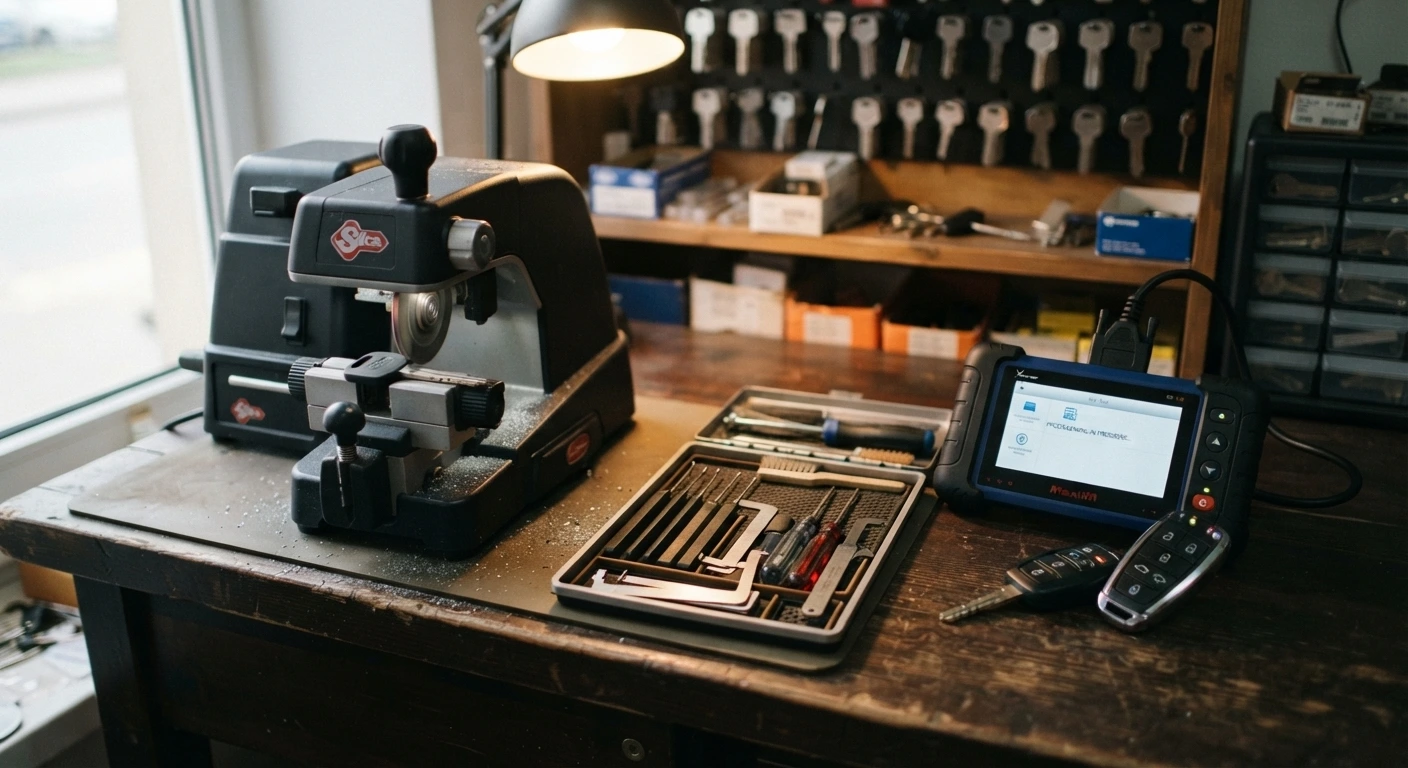

Replacing a modern car key often involves two separate jobs: cutting the physical key and programming its electronic components. Although these services are frequently performed together, they solve completely different problems.
Key cutting shapes the metal blade so it physically matches the locks or ignition. Car key programming electronically connects a transponder, remote, or smart key with the vehicle’s security system.
This distinction explains why a newly cut key can sometimes unlock a door but still fail to start the engine. The blade may be mechanically correct while the vehicle does not recognize the electronic code inside the key.
Car Key Cutting vs Programming at a Glance
| Feature | Car Key Cutting | Car Key Programming |
|---|---|---|
| Main purpose | Creates the physical key blade | Registers the electronic key with the vehicle |
| Works with | Mechanical locks and ignitions | Immobilizer, transponder, smart-key systems |
| Requires electronic equipment | Usually no | Usually yes |
| Can help unlock a door | Yes, with correct blade | Not by itself |
| Can authorize engine start | Not on many modern vehicles | Yes, when required |
| Needed for traditional metal key | Usually | Usually not |
| Needed for transponder key | Usually | Yes |
| Needed for smart key | Emergency blade may need cutting | Usually yes |
Understanding which type of key your vehicle uses determines whether you need one service or both.
What Is Car Key Cutting?
Car key cutting creates the physical shape of the key blade.
Traditional vehicle locks use mechanical components that correspond to specific cuts or grooves in the key. When the correct key is inserted, those components align and allow the lock or ignition cylinder to turn.
A replacement blade therefore has to match the original key pattern accurately.
Car Keys Can Use Different Blade Designs
Depending on the vehicle, the key may use:
- Traditional edge-cut blade
- Laser-cut or sidewinder blade
- Emergency blade stored inside a smart key
- Integrated blade attached to a remote
Older vehicles often use traditional edge-cut keys with visible peaks and valleys along one or both edges.
Many newer vehicles use sidewinder-style blades with a milled track through the face of the key.
These usually require different key cutting equipment.
How Can a New Car Key Be Cut Without the Original?
Losing every copy does not always mean the vehicle’s locks have to be replaced.
Depending on the vehicle and available information, a replacement key may be created using:
- Original key
- Key code
- Lock information
- Vehicle-specific data
The exact method varies by make, model, year, and key system.
A properly cut replacement should mechanically correspond to the vehicle’s lock system.
However, completing the blade is only part of the job when the vehicle uses an electronic anti-theft system.
What Is Car Key Programming?
Car key programming deals with the electronic identity of the key.
Many modern vehicles have an immobilizer system designed to prevent the engine from starting unless an authorized electronic key is detected.
Ford’s current owner information, for example, explains that its passive anti-theft system prevents the vehicle from starting when an incorrectly coded key is used.
The exact technology varies between manufacturers, but the principle is similar.
The vehicle expects an electronic credential it recognizes.
Programming May Involve
- Transponder chip
- Key fob
- Integrated remote key
- Proximity smart key
- Immobilizer system
Programming tells the relevant vehicle security system that the replacement key is authorized.
Without that step, the mechanical key and electronic security system may effectively disagree with one another.
What Is a Transponder Key?
A transponder key contains an electronic chip associated with the vehicle’s immobilizer system.
When the key is used, the vehicle checks whether it recognizes the coded key.
If the code is accepted, the immobilizer allows the engine to start.
If the electronic identity is wrong or missing, the vehicle may refuse to start even when the metal blade turns perfectly.
Ford’s anti-theft documentation specifically describes the system as requiring a correctly coded key before the immobilizer will disarm.
This Creates a Common Situation
Imagine you have a replacement key whose blade was copied perfectly.
It can enter the ignition, turn the ignition cylinder, and unlock the driver’s door. But the engine will not start.
That does not necessarily mean the blade was cut incorrectly.
The transponder may simply need programming.
Why Can a Key Unlock the Car but Not Start It?
Door access and engine authorization can be two separate processes.
The metal portion of the key can operate the mechanical door lock.
The immobilizer checks the electronic portion before authorizing the engine.
Mechanically correct: The blade matches the lock.
Electronically incorrect: The immobilizer does not recognize the transponder.
The result is a key that appears correct until you try to start the vehicle.
This is one of the clearest examples of why cutting and programming should not be treated as the same service.
What About Remote Buttons?
Remote lock and unlock functions add another layer.
A key may contain:
- Physical blade
- Transponder for starting
- Remote-control electronics
Depending on the vehicle, the remote portion and immobilizer portion may be programmed together or through different procedures.
Ford documents some integrated keys where a programming procedure registers both the immobilizer key code and the remote-entry portion at the same time.
Other vehicles use different processes.
This is why a remote that unlocks the doors does not always prove that the immobilizer portion of the key is working correctly.
How Are Smart Keys Different?
A smart key or proximity key does not normally need to be inserted into a traditional ignition cylinder.
The vehicle detects the key wirelessly when it is nearby.
The driver can then unlock the vehicle, enter, and press the start button.
The smart key still needs an authorized electronic identity.
Many Smart Keys Also Have an Emergency Blade
A hidden metal key can often be removed from the smart fob.
That blade may allow mechanical entry if the fob battery dies, the electrical system fails, or remote unlocking does not work.
In that situation, the emergency blade may need cutting while the electronic smart key still requires programming.
So even keyless vehicles can involve both services.
Does Every Car Key Need Programming?
No.
Older vehicles using purely mechanical keys may need only key cutting.
Programming becomes relevant when the vehicle uses electronic key authentication.
Cutting Alone May Be Enough When
- The vehicle uses a traditional mechanical key.
- The replacement key has no transponder.
- Key is only intended for a mechanical lock.
Programming Is Usually Needed When
- Replacement has a transponder chip.
- Vehicle uses an immobilizer.
- A new key fob is being added.
- Smart/proximity key is replaced.
- All programmed keys have been lost.
Always identify the exact key system before ordering a replacement.
Does Every Programmed Key Need Cutting?
No.
A proximity-only smart key may not use a visible ignition blade during normal operation.
Programming can be the main requirement.
However, many smart keys still contain an emergency mechanical blade, so that blade may also need to be cut if you want complete functionality.
A replacement fob with an uncut emergency blade is not necessarily a complete replacement.
Can You Program a Car Key Yourself?
Some vehicles allow owners to add a spare key through a manufacturer-defined procedure.
The requirements can be strict.
For example, certain Ford vehicles allow owner programming only when two previously programmed keys are already available.
That is very different from an all-keys-lost situation.
DIY Programming Depends On
- Vehicle year
- Make and model
- Key type
- Number of existing programmed keys
- Security system
A procedure found online for another year or trim should not automatically be applied to your vehicle.
Use instructions written specifically for the exact vehicle.
What Happens When All Car Keys Are Lost?
An all-keys-lost situation usually requires more work than creating a spare while a working key is available.
The job may involve:
- Verifying vehicle ownership.
- Identifying the correct key type.
- Creating the physical blade if required.
- Accessing the vehicle’s key or immobilizer system.
- Programming the replacement.
- Testing door, ignition, and remote functions.
Depending on the vehicle, existing missing keys may also be removed from the authorized key list.
That can be useful if the concern is that someone may find or possess the missing key.
Why Compatibility Matters Before Programming
A key fob that looks identical to the original is not automatically compatible.
Electronic keys can differ by:
- Frequency
- Transponder type
- Part number
- Vehicle generation
- Region
- Immobilizer system
Two fobs can use the same shell while containing different electronics.
Check Compatibility Before Buying a Replacement
Before ordering a key online, confirm the exact year, make, model, key type, and compatible part number where applicable.
Buying the wrong key can leave you with hardware that cannot be programmed to the vehicle.
What if the Key Was Programmed but Still Does Not Work?
Programming is not the only possible cause of a key problem.
Possible issues include:
- Defective transponder
- Damaged fob
- Wrong key type
- Vehicle receiver fault
- Immobilizer fault
- Weak vehicle battery
- Radio interference
A failed programming attempt should therefore be diagnosed rather than repeated indefinitely.
Ford’s current documentation, for example, distinguishes between a “No key detected” condition and a broader starting-system fault.
Key Cutting Problems Have Different Symptoms
A poorly cut blade tends to create mechanical symptoms. These can include:
- Key will not enter completely.
- Key will not turn.
- Key sticks.
- Door unlocks only after moving the key.
- Ignition cylinder feels unusually difficult.
Programming problems tend to create electronic symptoms instead.
Possible Programming Symptoms
- Key turns, but engine does not start.
- Immobilizer warning appears.
- “Key not detected” message appears.
- Replacement remote does not operate properly.
The distinction helps narrow down what should be checked first.
Do You Need Cutting and Programming for a Spare Key?
For most modern transponder-equipped vehicles, yes.
A complete spare should generally provide the same essential functions as the primary key, including mechanical door access, engine authorization, and remote operation.
If the replacement has only been cut but not electronically registered, it may work as an emergency door key but not as a functional driving key.
Why Making a Spare Before Losing Every Key Can Be Easier
A spare key is often simpler to create while at least one or two programmed keys are still available.
Some vehicles even allow limited owner programming under those conditions.
Once every key is gone, additional security procedures and equipment may be necessary.
A working spare also reduces the chance of being stranded while a replacement is arranged.
What Information Is Needed for Car Key Replacement?
When requesting key cutting or car key programming, have basic vehicle information ready.
Vehicle Information
- Year
- Make
- Model
- Trim where relevant
- VIN when requested
Key Situation
- Working key available
- Spare available
- All keys lost
- Key broken
- Fob damaged
- New replacement already purchased
Also expect ownership verification before a professional creates a key for a vehicle.
Which Service Do You Need?
Use this quick comparison.
You May Need Key Cutting When:
- Blade is broken.
- Replacement blade is blank.
- Original mechanical key is lost.
- Emergency smart-key blade needs duplication.
You May Need Programming When:
- New transponder key will not start the vehicle.
- Replacement smart key is not recognized.
- New fob needs to be added.
- Immobilizer rejects the new key.
You May Need Both When:
- Modern car key is completely lost.
- Full replacement key is being created.
- New integrated transponder key has a blank blade.
- Smart fob requires a cut emergency key.
The type of key, rather than the appearance alone, determines the correct service.
A Complete Car Key Replacement May Require Both Steps
Car key cutting and car key programming solve two separate parts of the same problem. Cutting creates a physical blade that corresponds to the vehicle’s locks or ignition, while programming gives a transponder, remote, or smart key the electronic authorization needed by the vehicle’s security system. On many modern vehicles, a correctly cut but unprogrammed key can unlock the door yet still fail to start the engine because the immobilizer does not recognize it.
At Hero Locksmith, we provide automotive key cutting, car key replacement, transponder-key services, key fob replacement, and car key programming throughout Walnut Creek and the surrounding Bay Area. If you have lost a key or purchased a replacement that still needs to work with your vehicle, contact us for automotive locksmith service so we can determine whether your key needs cutting, programming, or both.